Premium customers: earn 20% a year on a 3-month Locked Savings plan. Limited availability. Learn more.


Best Ways To Send Money From The UK To Nigeria In 2026
Discover the best ways to send money from the UK to Nigeria in 2026, compare the top transfer options, and see how Kuda helps you receive, manage, and use money in Nigeria with ease.
May 12th, 2026
Introduction
Sending money from the UK to Nigeria is still a big part of life for many Nigerians abroad. Whether you’re helping family, paying school fees, supporting a business, or covering urgent expenses, the goal is usually the same: get money home quickly, safely, and without losing too much to fees and exchange rate markups.
The good news is that there are now plenty of ways to do it. You can use fintech apps, banks, agent networks, and other remittance services, and many of them offer faster transfers, clearer pricing, and better tracking than before.
In this guide, we’ll look at the best ways to send money from the UK to Nigeria in 2026, what to compare before you hit send, and how Nigerians in the diaspora can stay in control of their money once it reaches Nigeria.
The money transfer landscape in 2026
The UK to Nigeria route is still one of the busiest remittance corridors for Nigerians abroad, which is why so many providers keep improving their services for this market. More people now expect mobile-first transfers, instant updates, simple KYC, and bank deposit options that work smoothly in Nigeria. Exchange rates also continue to move around, so the exact amount someone gets in naira can change from one transfer to the next. That means the best choice is not just the one with the lowest fee, but the one that gives you the best total value after fees and exchange rate are added together. Another thing to keep in mind is that different providers do different things well. Some are faster, some have better rates, some are easier to use, and some are better for larger transfers or repeat payments.
Best ways to send money from the UK to Nigeria
1. Fintech transfer services
These are built for people who want a fast, simple, mostly app-based experience with clear steps and live transfer tracking. Popular options in this space include:
- Wise.
- Remitly.
- WorldRemit.
- Sendwave.
- LemFi.
- Pesa.
- PayPal/Xoom.
These apps usually let you:
- Send money from your phone.
- See the rate before you pay.
- Pick bank deposit or other payout options.
- Track the transfer from start to finish.
- Save recipient details for next time.
Why people like them:
- They’re easy to use.
- They’re often faster than banks.
- They usually show the fee and rate before you confirm.
- They fit the way many people already manage money today.
Some of these apps also run occasional rate boosts or cashback promotions for UK senders to Nigeria, which can make them even more appealing if you send money often.

2. Traditional banks
Banks like Barclays, HSBC, and Lloyds still offer international transfers from the UK to Nigeria. If you already use a bank for your main money needs, sending from there can feel familiar and straightforward. Banks can work well if you want:
- A transfer from your existing account.
- A provider you already trust.
- A more traditional setup.
But they are often slower than fintech apps, and the total cost can be higher once you factor in fees and exchange rate markups. That’s why banks are usually better for people who value familiarity over speed or savings.
3. Western Union and other agent-based networks
Western Union is still a strong option in 2026, especially for people who want a wide network and the choice of sending online or at an agent location. It can help if you want more flexibility in how you pay or how the recipient gets the money.
Western Union’s UK service lets you:
- Start a transfer online.
- Choose Nigeria as the destination.
- Enter the recipient’s details.
- Pay online or at an agent location.
- Track the transfer with a reference number.
This kind of service can be useful if:
- You want cash-style support.
- You need a provider with a big physical presence.
- You prefer a more established remittance brand.
It may not always be the cheapest option, but it can be dependable when you need something widely available.
4. MoneyGram and similar global remittance brands
MoneyGram remains part of the global money transfer picture in 2026, alongside Western Union and other cross border brands. These services are often used when people want a familiar remittance name with broad reach and different payout choices.
They can be a good fit if you want:
- An established international transfer brand.
- A choice between online and in-person sending.
- A transfer method that feels simple and predictable.
As always, it’s worth comparing the final amount your recipient gets, not just the fee shown up front.
5. Direct bank and remittance partners
Some transfer providers work directly with banks or local payout partners in Nigeria. That can make it easier for money to land straight in a Nigerian bank account without extra steps.
This setup is useful when:
- The recipient prefers a bank deposit.
- You want fewer moving parts.
- You’re sending a transfer for bills, family support, or business use.
In many cases, this is one of the cleanest ways to send money because the money arrives where it’s needed without much friction.
Comparing your options To get the best value, it helps to compare a few things side by side. Check these first:
The exchange rate. A better rate can save you more than a lower fee.
The transfer fee. Look at the full cost, not just the headline price.
Speed. Some transfers arrive in minutes, others take one to five days.
Payout method. Make sure the recipient can receive the money the way they need.
Transfer limits. Some providers are better for small transfers, others for larger ones.
Ease of use. A clear app can save you time every time you send.
If you send money regularly, these details matter a lot. A small difference on each transfer can add up across a year.
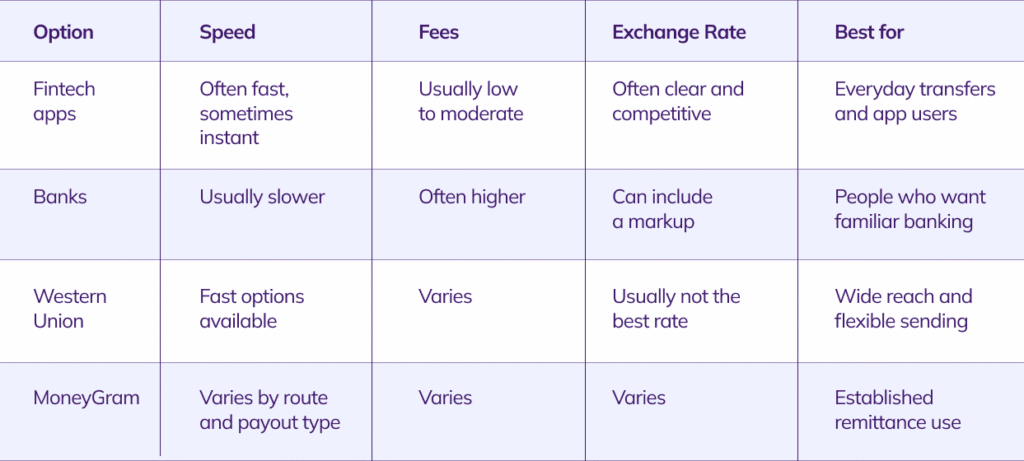
The best choice depends on what matters most to you: speed, total cost, payout method, or convenience.
More options to consider
- LemFi: Active on the UK-to-Nigeria route and focused on low-friction transfers for diaspora users.
- Pesa: Positioned around UK-to-Nigeria transfers with direct bank deposit and competitive pricing.
- UBA remittance services: Useful if you prefer a bank-linked route with Nigerian banking support.
- Other local payout partners: Some providers route money through Nigerian banking partners to make payout smoother.
These options matter because the market is not standing still. More providers are building around the needs of Nigerians abroad, which means better choice, more competition, and sometimes better value.
How to get the best exchange rate
- Check the mid-market rate before sending.
- Compare at least two or three providers.
- Watch for “zero fee” claims that hide a weak exchange rate.
- Send when the rate works for you, especially if you send often.
If you transfer money regularly, some apps also send rate alerts or run short-lived boosts that can help you time things better.
Common mistakes to avoid
People lose money on transfers more often than they should, usually because they rush the process.
Avoid these mistakes:
- Sending without checking the total amount your recipient will get.
- Ignoring the exchange rate.
- Using a provider that feels cheap but hides extra cost in the rate.
- Entering the wrong account number or name.
- Sending money through a service you don’t trust.
Rules and safety
Money transfer companies that operate in the UK must follow the right regulatory rules, and the transfer route to Nigeria can also be affected by local payout rules and compliance checks. For larger transfers, you may need to explain where the money came from. It also helps to stay alert for scams. Only send to people you know and trust, and never rush into a transfer because someone says it’s urgent. That habit matters just as much as the provider you choose. Sending money is one part. How you receive and manage it matters just as much.
Once the money gets to Nigeria, the next step is just as important. You need a simple way to receive it, use it, and stay in control without depending on someone else every time you want to check a balance or move money around. That is where Kuda fits in.
How Nigerians in the UK can manage money back home
If you’re in the diaspora, having a Nigerian account so you can manage remotely makes life easier. With Kuda, you can manage the following remotely:
- Easy naira-to-naira transfers.
- Simple bill payments and local spending.
- A clear view of your money in one place.
You can also use Kuda’s multicurrency wallet to send GBP or EUR to other Kuda users. It makes cross-border transfers simple and easy. This mix of access and control makes the money feel easier to handle.
Conclusion
In 2026, there are more ways than ever to send money from the UK to Nigeria. Fintech apps, banks, Western Union, MoneyGram, and newer names like LemFi and Pesa all give you different ways to move money home, so the best choice depends on what matters most to you. But sending money is only half the story. Once it reaches Nigeria, Kuda helps you receive it, move it locally, pay bills, and stay in control from anywhere. Choose the sending method that gives you the best value, then use Kuda to manage your money in Nigeria with less stress and more control.