Premium customers: earn 20% a year on a 3-month Locked Savings plan. Limited availability. Learn more.


How To Get A Personal Loan In Nigeria In 2026
Learn how to get a personal loan in Nigeria, from requirements to tips for easy approval. Borrow smartly and explore Kuda Overdraft.

Introduction
If you’ve ever tried to apply for a loan and you found the process overwhelming, you’re not alone.
For a lot of people, taking a loan is scary and stressful. The forms seem complicated and the terms can be confusing, there’s the threat of embarrassing calls about repayment and shameful messages to friends and family, maybe even the fear of rejection.
In this guide, we’ll tell you what loans are, what you need to get one, and how to get one without giving yourself a headache.
What’s a loan?
It’s simple, a loan is money you borrow now and pay back later. Sometimes, there’s an extra cost for borrowing called interest.
People take loans for all sorts of reasons: unexpected bills, rent or school fees, starting or growing a business, or big purchases like land.
Why do people take loans?
People often take loans because their needs can’t wait or they have no other option. For example, their rent could be due, they might need to pay their child’s school fees, or they just can’t make it to the end of the month without some help because transport, food, data, and other costs of daily life have finished their salary. It happens.
Borrowing money isn’t necessarily a sign that you’re failing or bad with money. It could be that you need some extra funds to make an investment that might pay off later. What’s important is that you only borrow what you can comfortably repay.
Some loan-related words you should know
Lender: The person or business you’re borrowing money from.
Principal: This is the amount you borrow.
Interest: This is the fee charged on the principal (the amount you borrow). If you borrow ₦100,000, you might pay back ₦110,000. That extra ₦10,000 is the interest.
Tenor or tenure: This means the time the lender gives you to repay the loan.
Collateral: Something of value that you commit to get a loan. If you don’t repay the loan, the lender could keep the collateral or sell it to get their money back.
Terms: The conditions you must agree to before your application for a loan is approved. These include the principal you’re borrowing, the interest rate and interest you must pay, and the repayment schedule (when you’ll repay the loan).
Guarantor: A person that guarantees your loan. The lender may reach out to them if you can’t repay the loan.
Repayment: The amount you must pay back as scheduled.
Overdraft vs Traditional Loan
An overdraft lets you spend more than you have in your account, while a loan is money you borrow from a bank, a loan app, or any other lender and agree to pay back over a set period with interest.
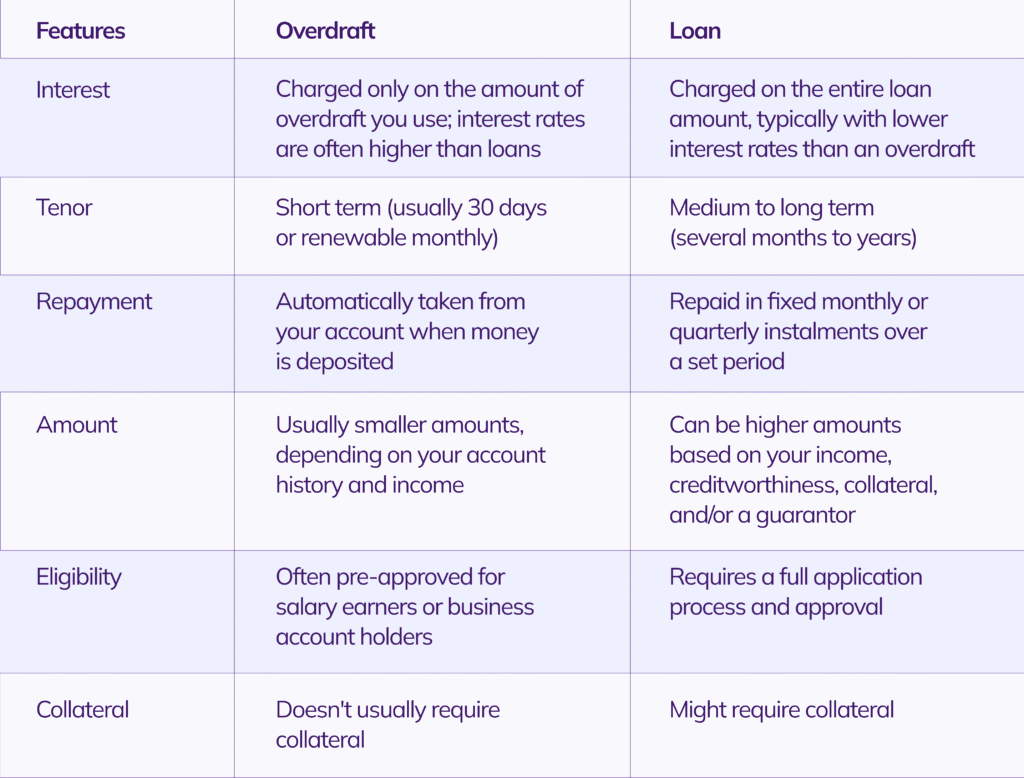
If you use your Kuda account regularly and have a good credit score, you could qualify for Kuda Overdraft which gives you instant access to money without paperwork or collateral.
What kind of loans are available in Nigeria?
1. Personal loan
This is money you borrow for personal needs like emergencies, rent, school fees, travel, etc. Banks and other lenders typically give personal loans based on your credit score and how much they believe you can repay from your regular income.
2. Mortgage loan
This is money you borrow to buy property like land or houses. Banks or mortgage institutions offer this kind of loan, and the property itself is the collateral. Once you repay the loan and meet all other conditions, the property becomes yours.
3. Business loan
A business loan is designed to help a small business, startup, or an established company manage their daily operations or scale. Lenders will check your business’ financial strength and history before giving you a loan.
4. Agricultural loan
This is only given for agricultural purposes like crop production, livestock farming, farming equipment purchases, or agribusiness development. It’s usually offered by government-backed institutions, commercial banks, or specialised institutions at lower interest rates.
5. Student loan
Designed to help students in universities cover fees, accommodation, books, and other education-related expenses. It’s usually offered at a low interest rate with flexible repayment that begins after graduation or getting a job.
What do you need to apply for a loan in Nigeria?
- Meet KYC requirements: Lenders need to know who you are. They’ll ask for your age, Bank Verification Number (BVN), a valid ID, and proof of your income. This helps them decide if you’re eligible for a loan.
- A good credit history: A good history of borrowing and repaying on time increases your chances of approval. Every Nigerian is entitled to a free credit report every year from any licensed credit bureau.
- Relevant documents: Be ready to upload or submit documents like a utility bill, your bank statement (usually for the last three to six months), your payslips, and/or your employment letter. These help confirm your income and financial stability.
- Collateral or a guarantor: Depending on the kind of loan and/or the amount you’d like to borrow, you may need to commit something valuable (like land, a car, or a building) as collateral. Some lenders, especially for smaller loans like student loans, may accept a guarantor instead.
How do I apply for a loan in Nigeria?
1. Be sure of what you need: Why do you need the loan and how much do you need? This will help you decide the kind of loan to apply for.
2. Choose a trusted lender: Look for a bank or some other lender that offers the kind of loan you want. Make sure they’re licensed and have good reviews.
3. Create an account: Sign up on the lender’s mobile app or website, or open an account at their office.
4. See if you qualify: Most lenders will show you the basic requirements for a loan. Make sure you meet them and gather all the documents you need to apply.
5. Apply: Fill the loan application form correctly and upload or submit your documents.
6. Wait for a response: If your application is successful, you’ll get a message, and the money will be sent to your bank account.

How to borrow on the Kuda app
If you use your Kuda account regularly and have a good credit score, you may qualify for Kuda Overdraft.
1. Tap the banner on your Kuda app prompting you to take an overdraft.
2. Tap Take An Overdraft and we’ll run a quick credit check to confirm your eligibility.
3. If you’re eligible, we’ll make you an offer on your Kuda app.
4. If you accept our offer, you’ll be able to set your overdraft limit.
5. After setting your limit, tap Done, then confirm with your transaction PIN, fingerprint, or Face ID and tap Okay.
How to increase your loan approval chances
- Maintain a good credit score: Always repay loans on time. It builds trust with lenders.
- Don’t apply for several loans at once: It makes you look desperate and lowers your chances of getting a loan.
- Be honest about your information: Always fill in the right details when you’re applying for a loan. Your application may be rejected if your details aren’t correct.
- Start small: Apply for a small loan first and repay it on time to build a strong repayment history.
Important questions to answer before taking a loan
Why do you need the loan?
Only borrow when it’s necessary, like in an emergency or for an investment that is likely to give you returns.
How much can you afford to repay?
Don’t borrow more than your income can handle. Missing a repayment can lead to losing your collateral, embarrassment, or a bad credit score. You could even be sued by the lender.
Is the lender licensed?
Don’t borrow from unlicensed lenders or loan sharks. You could get into serious trouble.
Do you understand the terms?
Know the interest rate, the repayment schedule, fees, and any other charges. Once you agree, you’re legally bound to follow the terms.
Have you confirmed the interest rate?
If the interest is unreasonably high compared to the amount you want to borrow, it might not be worth it.
Before you go
There’s no shame in taking a loan. It’s a financial tool. If you use it wisely, it can help you secure an opportunity, solve a problem, or build something.
Just remember to read the terms of the loan, understand how much you’ll repay, and make sure you’re borrowing from a trusted lender. Never, ever borrow what you can’t repay and never deal with loan sharks.
Explore safe borrowing options like Kuda Overdraft.