Premium customers: earn 20% a year on a 3-month Locked Savings plan. Limited availability. Learn more.


Types Of Payment Cards In Nigeria: Advantages And Differences
Everything you need to know about payment cards, including their types, features, and advantages.
May 8th, 2026
Introduction
If you were in Nigeria between late 2022 and early 2023, you probably remember how difficult it was to get cash. At some point, people were buying cash with cash. This happened because the Central Bank of Nigeria (CBN) introduced redesigned banknotes. Today, payment cards have made life a whole lot easier. You don’t have to depend on cash. You can simply tap, swipe or type in your details and move on with your day. In this article, we’ll explain the different types of payment cards in Nigeria, how they work and what to consider before choosing one.
What are payment cards?
Payment cards are tools linked to your bank account, used to pay for things or services without physical cash. They come in different forms – virtual, physical, credit or debit, each with unique features and benefits. Apart from making payments easier, payment cards also help you keep track of your spending. Every transaction shows up in your account statement, so you can see where your money is going and plan better.
Why are payment cards popular in Nigeria?
In 2012, the Federal Government of Nigeria introduced the cashless policy through the Central Bank of Nigeria (CBN) to reduce reliance on physical cash and encourage digital payments. It also aimed to improve transparency, increase financial inclusion, efficiency, and reduce corruption. Since then, more businesses accept card payments, and more people rely on them for everyday transactions. With different payment card options available, understanding how each card works will help you choose the right one for your needs.
Types of payment cards in Nigeria
Debit cards
A debit card is directly linked to your bank account. When you pay with it, the money is taken from your account immediately. If you don’t have enough money in your account, the transaction won’t go through. Some banks, such as Kuda, may offer an overdraft for additional funds. Debit cards are the most common type of payment card in Nigeria because almost every bank account comes with one. They are simple to use and work for both online and offline payments.
Apart from online and in-person payments, debit cards also let you withdraw cash from ATMs, which is something virtual cards can’t do. This makes them a more practical option if you still need access to cash from time to time. Examples of debit cards are the Kuda Card, GTBank Mastercard, Access Bank Verve, and Zenith Visa Debit.
Key features of a debit card
- Your money is deducted from your account instantly when you pay.
- You can withdraw cash from ATMs anytime.
- Your card is protected with your PIN and security checks.
- Issued by traditional banks and fintechs for personal or business use.
- Linked directly to your account number.
- Works for things like subscriptions and recurring payments.
Advantages of debit cards
- It’s quick and easy for your daily spending.
- It’s easier to stick to your budget since you can only spend what’s in your account.
- It works almost everywhere in the world.
- You can track your money easily through your account statement.
- You can use it to withdraw cash, send money, and pay bills.
- Reduces the risk of accumulating debt, since transactions are based on existing account balances.
Credit cards
A credit card lets you spend money now and pay later. Instead of using your own money, the bank gives you a credit limit, which is the maximum amount you can spend. Unlike a debit card, you do not need to have money in your account at the time of purchase.
Credit cards are helpful for big purchases or emergencies. They just need to be used carefully to avoid accumulating debt due to high-interest rates and fees. In Nigeria, credit cards are widely accepted, especially for international payments. Examples include the Stanbic IBTC Credit Card, GTBank Mastercard Credit Card, and Zenith Bank Visa Credit Card.

Key features of a credit card
- Allows purchases even when low on cash.
- Interest free if repaid within the agreed time.
- May come with extra benefits like cashback, reward points, insurance, or travel perks.
- Ideal for personal use or for businesses with spending limits for employees.
Advantages of Credit Cards
- Useful for emergencies or unexpected expenses.
- No interest charges if repaid on time within the due date.
- Helps build a good credit history when used responsibly.
Prepaid cards
A prepaid card lets you spend only the amount you load onto it. Once the money on the card is spent, you won’t be able to use it again until you top it up. Unlike debit or credit cards, prepaid cards are not linked to a bank account. This makes them a good option if you want to keep tighter control over your spending.
Prepaid cards are often used for budgeting, gifting, and online shopping. They’re also safer than carrying cash because you can block them if they get lost or stolen. However, some prepaid cards may come with fees for loading or maintenance, and you can’t spend more than what you’ve added to the card.
In Nigeria, examples include the Verve Prepaid Card and Mastercard Prepaid Card, which are used for both local and international payments.
Key features of a prepaid card
- Works locally and internationally through major payment networks.
- Limits your spending to only what you’ve loaded.
- Some prepaid cards are easy to get without sharing a lot of personal details, which gives you a bit more privacy with your money.
Advantages of prepaid cards
- Helps reduce the risk of overspending.
- Accessible to individuals without a bank account or strong credit history.
- Offer protection through PIN security and fraud monitoring.
Virtual cards
A virtual card is a digital payment card designed for online or contactless transactions. It doesn’t come as a physical card, so everything lives on your phone or banking app. Most virtual cards are linked to your bank account or wallet, and you can create one in seconds. Once it’s set up, you can start using it immediately for payments online.
One of the main reasons people use virtual cards is security. They help reduce the risk of fraud by keeping your card details from being exposed online, and they’re easy to control from your app. However, they cannot be used for in-person purchases or ATM withdrawals.
In Nigeria, it is becoming more popular, especially with people who shop online often or pay for subscriptions. Examples include the GTBank Virtual Card, Kuda Virtual Card, and Opay Virtual Card.
Key features of a virtual card
- Exists only in digital form and is managed through your app.
- Designed mainly for online payments.
- Easy to activate and use without physical card issuance.
- Usually linked to a bank account, similar to a debit card.
Advantages of virtual cards
- Enhanced security by protecting primary card details from exposure.
- Makes online payments safer and easier.
- Removes the need to carry a physical card.
- Lets you set spending limits to manage your money better.
- Can be used for both local and international payments.
Differences between payment cards in Nigeria
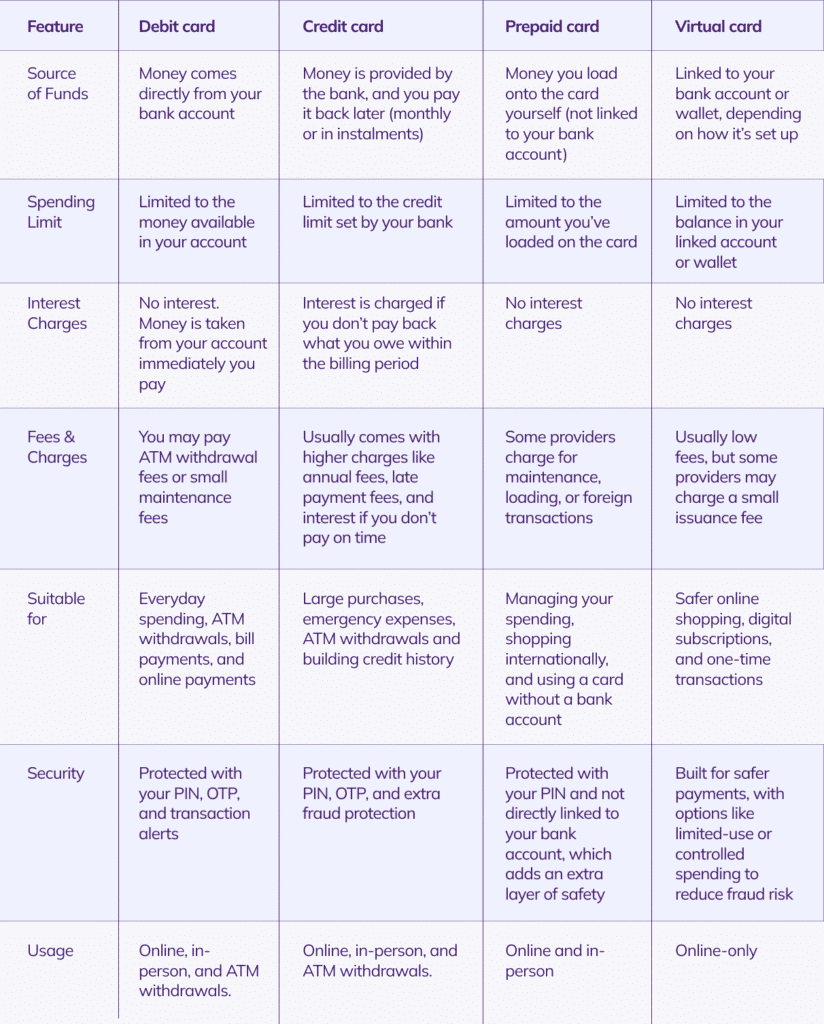
What to consider when choosing a payment card
Before you pick a payment card, it helps to think about how you plan to use it and what matters most to you.
- Fees and charges: Some cards have annual fees, maintenance fees, or transaction charges, while others offer cashback or rewards and points.
- Where you can use it : Not every card works everywhere. Make sure your card works for local payments, international transactions, and online shopping, especially if you plan to travel or shop from global stores.
- Security features: Your card should help keep your money safe. Look out for things like PIN protection, transaction alerts, OTPs, and extra security layers that help prevent fraud.
- Transaction limits: Cards often come with daily or per-transaction limits. These limits can depend on your account type or the kind of card you have, so it’s worth checking if they match how you spend.
- Convenience: Think about what works best for you. You might prefer a physical card you can carry around, a virtual card you can use online, or both.
Advantages of using Kuda payment cards
With Kuda, your card is built to make payments simple and easy to manage.
- No maintenance fees: You won’t be charged maintenance fees, so you get to keep more of your money.
- Works where you need it: Kuda cards work for both in person and online payments globally.
- Convenience: Your money is always within reach, and payments are quick and straightforward.
- Financial management: You can track your spending on your Kuda app.
- Enhanced Security: If anything goes wrong, you can block your card instantly. Your transactions are also protected with your PIN, fingerprint, or Face ID.
Frequently asked questions (FAQs) about payment cards
1. What are the four types of payment cards in Nigeria?
The most common types are credit cards, debit cards, virtual cards, and prepaid cards.
2. What does a payment card do?
A payment card helps you pay for things or withdraw money without cash.
3. How do card payments work?
When you pay with your card, the money is either taken from your account or charged to your credit, depending on the card type. You can use it to pay online or in person.
4. Which card is best for online payments?
Virtual cards are usually the best option for online payments because they’re easy to use and add an extra layer of security.
5. What are the typical fees associated with payment cards in Nigeria?
This depends on the card, but common charges include card issuance fees, maintenance fees, ATM withdrawal fees, POS charges, late payment fees for credit cards, and card replacement fees.
6. What’s a Kuda virtual card and how do I get it?
A Kuda virtual card is a digital version of your card that you can use for online payments. To request a virtual Kuda card, follow the steps below:
- Open your Kuda app.
- Tap Cards.
- Tap Request A Card.
- Tap Get A Virtual Card.
- Confirm your request with your transaction PIN, fingerprint, or Face ID.
- Create your card PIN.
- Submit your virtual card request
7. How do I set daily card spending limits on Kuda?
After activating your card, follow the steps below to set your card spending limits:
Open your Kuda app, then tap Cards.
Tap Manage Card, then tap Manage Channels.
Choose POS, ATM, or Online Payments
Slide the toggle to set a daily spending limit and tap Save.
8. How do I change my card PIN on Kuda?
You can change your PIN in the Cards section of your Kuda app. If you use the wrong PIN three times at an ATM, you can still change your PIN on the Kuda app. Just make sure your first card transaction after changing your PIN is at an ATM.
9. Do you get charged a maintenance fee for a Kuda card?
No, Kuda doesn’t charge card maintenance fees.
Conclusion
Payment cards make everyday payments faster, easier, and more secure. Debit cards let you spend the money you already have, credit cards give you the option to pay later, prepaid cards help you stay within a set budget, and virtual cards make online payments safer. Understanding how each one works makes it easier to choose what fits your needs and how you spend.