Premium customers: earn 20% a year on a 3-month Locked Savings plan. Limited availability. Learn more.


What The 7.5% VAT On Transaction Fees Really Means
Nigeria introduced a 7.5% VAT on banking service fees from January 19, 2026. Learn what’s taxed, what’s not, and how it affects your everyday transactions.
Feb 16th, 2026
Introduction
From January 19, 2026, the Federal Government of Nigeria introduced a 7.5% Value-Added Tax (VAT) on bank transaction fees.
In simple terms, this means that you now pay an additional 7.5% on the service fees that traditional and digital banks charge for processing your transactions.
So if, for example, you transfer ₦50,000 to a friend, the 7.5% VAT applies to the transfer fee of ₦50.
What VAT means for banking
You already pay VAT on things like airtime, data, and restaurant orders. Now, it applies to banking service fees as well.
Before January 2026, most banking fees didn’t include VAT. The Nigeria Revenue Service (NRS) changed this to standardise tax collection across all sectors.
What’s taxed and what isn’t?
Only the following bank services are taxed:
- POS transaction service fees
- Bank transfer fees
- Mobile banking charges
- USSD transaction fees
- POS activation fees
- Card issuance and maintenance fees
- Loan processing fees
VAT doesn’t apply to:
- Interest earned on your savings account
- Returns from fixed deposits
- Loan interest repayments
- The principal amount of any transaction
How this affects your everyday transactions
Bank transfers
Example: You send ₦50,000 to your friend. Your bank charges a transfer fee of ₦50 and the Federal Government charges 7.5% VAT on the transfer fee.
The maths:
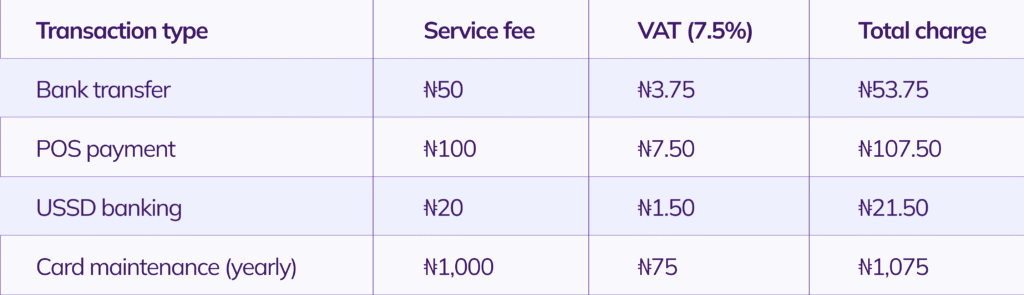
Transfer fee: ₦50
VAT (7.5% of ₦50): ₦3.75
Total charge: ₦53.75
₦50,053.75 leaves your account and your friend receives ₦50,000.
POS payments
Example: You pay ₦15,000 for rice and beans. A POS transaction fee of ₦100 is added and the Federal Government charges 7.5% VAT on the POS transaction fee.
The maths:
POS transaction fee: ₦100
VAT (7.5% of ₦100): ₦7.50
Total charge: ₦107.50
₦15,107.50 leaves your account and the shop receives ₦15,000.
USSD banking
Example: You dial a code to check your account balance. The USSD service fee is ₦20.
The maths:
USSD fee: ₦20
VAT (7.5% of ₦20): ₦1.50
Total fee: ₦21.50
Your banking costs haven’t changed much
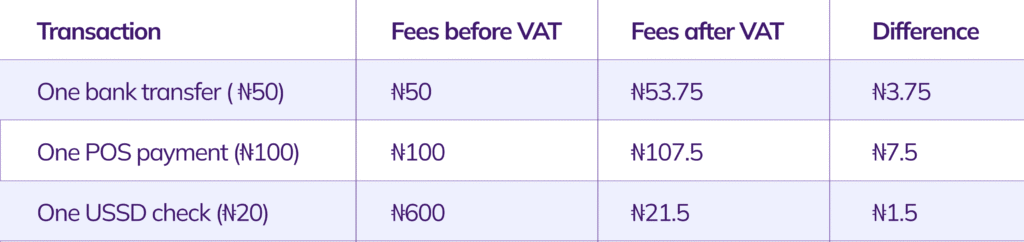
Here’s what you’d have paid before January 19, 2026 compared to after:
Drag
Depending on how often you make transactions, you might pay between ₦1.5 and ₦7.5 more per transaction. It’s not a lot, but it adds up.
What this means for you
Your banking fees will be slightly higher. Instead of paying ₦50 for a transfer, you’ll pay ₦53.75. Instead of ₦100 for a POS charge, you’ll pay ₦107.50.
But your transfer or payment amount stays the same. If you send ₦50,000, your recipient gets ₦50,000. If you withdraw ₦20,000, you receive ₦20,000. The VAT is only on the service fee.
How to reduce banking fees
1. Use banking apps instead of USSD.
USSD services charge a fee every time you check your balance. Most banks have mobile apps, so use the apps instead. You’ll be able to check your account balance for free.
2. Combine your transactions.
Instead of making ten small transfers throughout the week, consider sending money once or twice in larger amounts if you can. This reduces the total amount of fees you’ll pay.
3. Use free transfers.
Use a bank that offers free transfers every month. Find out what your free transfer limit is and plan around it. Kuda, for example, offers 25 free transfers monthly. Use those free transfers instead of paying transfer fees somewhere else.
4. Track your fees.
Check your transaction history at the end of every month. Once you understand your spending patterns, you can adjust them to minimise fees. For example, doing one major food shopping per month instead of making small purchases throughout the month could reduce POS or transfer fees.
Frequently asked questions
1. Is VAT charged on the amount of money I transfer?
No, VAT is only charged on the fee you pay for making the transfer.
2. Why am I seeing extra charges on POS transactions?
The extra charge is the 7.5% VAT on the POS service fee. If the service fee is ₦100, the VAT adds ₦7.50, making the total ₦107.50.
3. Is VAT applied to transfer fees on banking apps like Kuda?
Yes, VAT is applied to service fees paid at all banks in Nigeria.
4. Will the VAT rate change in the future?
The VAT rate could change if the Federal Government announces a new tax policy.
5. Does VAT apply to interest on my savings?
No, VAT doesn’t apply to interest earned on savings accounts and investments.
6. Are business accounts affected differently?
No, business accounts follow the same VAT rules. If your business pays a service fee, the 7.5% VAT will be applied to the fee.
You’re still in control of your money
The 7.5% VAT only applies to service fees, not transaction amounts. Your transaction costs will be minimally higher, but making transactions smartly and using the free transfers that banks like Kuda offer will help you keep those costs low.
You now know what you’re paying for and why. When you know where your money’s going, you’re always in control.