Premium customers: earn 20% a year on a 3-month Locked Savings plan. Limited availability. Learn more.


How To Calculate Loan Interest Rate In Nigeria
Learn how to calculate loan interest rates in Nigeria with simple and compound formulas. Understand fixed versus variable rates, see real-life examples, and get tips to borrow wisely.

Key Points
- A loan interest rate is the cost of borrowing money, usually shown as a percentage of the amount you take.
- There are two main ways interest is calculated: simple interest (on the original amount only) and compound interest (on the amount plus accumulated interest).
- Simple interest is easier to calculate and more predictable, while compound interest grows faster over time.
- Interest rates can be fixed (stay the same) or variable (can change based on market conditions).
- Loans may use flat rates (calculated on the full amount) or reducing balance rates (calculated on the remaining balance), which usually cost less over time.
- Your interest rate depends on factors like your credit score, the kind of loan you take, the loan amount, the repayment period, and where you borrow.
- Banks often offer lower annual rates but have stricter requirements, while loan apps are easier to borrow from but may charge higher rates.
- Always compare lenders, check the total repayment cost, and use a loan calculator before accepting any loan offer.
Introduction
Interest rates can seem a bit confusing at first, but understanding them is important to your financial health. Whether you’re saving, taking a loan, or investing, rates can have a big impact on your money.
We’ll explain interest rates in simple terms, how to calculate them, and how important they are to your finances.
What’s a loan interest rate?
A loan interest rate is the cost you pay to a lender (like a bank or a loan app) for borrowing money.
If, for example, you borrow ₦100,000 at an interest rate of 10%, you’ll repay ₦110,000. The ₦10,000 on top of what you borrowed is interest.
The interest rate is usually a percentage of the principal or the amount borrowed. You, the borrower, pay the lender for using the money over a specific period, such as a year, month, week, or day, as agreed when the loan is arranged.
How to calculate loan interest rate
1. Simple interest
Simple interest is interest you pay only on the original amount you borrowed (also known as principal).
How does simple interest work?
- You only pay a fixed percentage on the amount you borrowed..
- The interest stays the same throughout the duration of the loan. It doesn’t increase, even if you haven’t repaid the loan.
- Most personal loans and short-term bank loans in Nigeria charge simple interest.
How to calculate simple interest
Simple Interest = (Principal × Rate × Time) ÷ 100
- Principal is the original loan amount (e.g., ₦10,000)
- Rate is the annual interest rate (e.g., 5%)
- Time is the loan duration in years (e.g., 1 year)
Example
If you borrow ₦10,000 at a 5% interest rate for one year:
- Interest = (10,000 × 5 × 1) ÷ 100 = ₦500
- Total repayment = ₦10,000 (principal) + ₦500 (interest) = ₦10,500
2. Compound interest
Compound interest is interest you pay on money you borrow, and the interest added to it over time.
With compound interest, debt grows faster because the interest keeps building on top of itself.
Compound interest is usually charged on credit card debt, long-term loans, or investment-based loans.
How does compound interest work?
The interest is added to your loan balance at regular intervals (monthly, quarterly, or annually). Once it’s added, it becomes part of your loan and over time, you pay more than you would with simple interest.
How to calculate compound interest
The formula for calculating compound interest is A = P(1 + r/n)ⁿᵗ
- A is the total repayment (principal + interest)
- P is the principal (e.g., ₦10,000)
- r is the annual interest rate (in decimals)
- n is the number of times interest is compounded per year
- It is the loan duration in years
Example
If you borrow ₦10,000 at 10% annual interest compounded for two years:
A = 10,000(1 + 0.10/1)¹×² = 10,000(1.1)² = ₦12,100
Total interest = ₦12,100 – ₦10,000 = ₦2,100
You’ll repay a total of ₦12,100.
3. Fixed and variable interest rates
What’s a fixed interest rate?
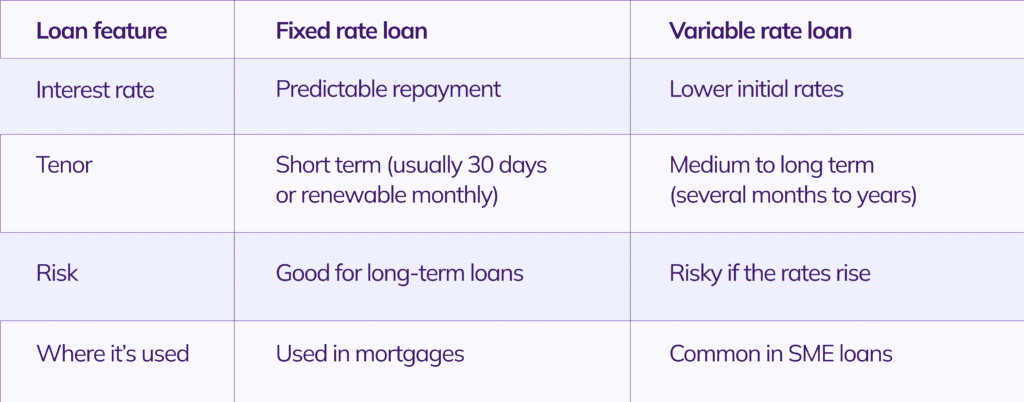
A fixed interest rate stays the same throughout the duration of a loan. The interest doesn’t change even if market conditions do, which means that your monthly payments are predictable, making it easier for you to budget.
What’s a variable interest rate?
A variable (or floating) interest rate may change during the duration of a loan based on market rates or CBN policy rates (like the Monetary Policy Rate). This means that your monthly repayments could decrease or increase.
4. Flat and reducing balance interest rates
What’s a flat interest rate?
A flat interest rate is interest charged on the full original loan amount for the entire duration of the loan regardless of how much has been repaid. A flat interest rate is commonly charged on car loans, salary advances, or some microfinance loans in Nigeria.
What’s a reducing balance interest rate?
A reducing balance interest rate is interest charged on the loan balance after each payment. This means you pay less interest over time. It’s usually charged on mortgages and long-term business loans.
Example
Let’s say you take a ₦500,000 loan at 20% interest for a year:
Flat interest rate
Interest = (₦500,000 × 20% × 1) ÷ 100 = ₦100,000
Total Repayment = ₦600,000
Reducing balance interest rate
Because the interest rate is recalculated monthly as the loan balance decreases, you might end up paying between ₦55,000 and ₦65,000 in interest depending on your repayment schedule.

Factors that affect loan interest rates in Nigeria
1. Your credit score
Your credit score shows how trustworthy you are when it comes to borrowing money and repaying it. If you have a poor credit history, like unpaid loans or late repayments, you may either be denied a new loan or you’ll be charged a higher interest rate. To build a good credit score and borrow at lower interest rates, always repay your loans on time and in full.
2. The kind of loan you’re taking
The kind of loan you take and why you take it can affect how much interest you’ll pay. Lenders calculate risk differently. For instance, secured loans like salary advances (where your salary is the collateral) often have lower rates since the lender faces less risk.
3. The duration and amount of the loan
How long you take to repay a loan (the duration, tenor, or tenure) and how much you borrow could decrease or increase interest. Generally, the longer the loan duration, the more interest you will pay in total, even if the monthly payments look small.
Example
If you borrow ₦500,000 at 15% simple interest for a year, you’ll pay:
₦500,000 × 15 × 1 ÷ 100 = ₦75,000
If you borrow for three years, you’ll pay:
₦500,000 × 15 × 3 ÷ 100 = ₦225,000
4. Where you borrow
Traditional banks and microfinance banks in Nigeria generally offer lower annual interest rates than loan apps. That’s because licensed banks are regulated by the CBN and usually have stricter loan processes and more manageable repayment schedules than loan apps.
5. Economic conditions
Inflation, exchange rates, and government policies all have an impact on how much it costs to borrow money.
When the CBN raised the Monetary Policy Rate (MPR) from 22.75% to over 27% in 2025, commercial banks raised their loan interest rates to cover higher borrowing costs. The role of inflation is considerable too – when the naira loses value, lenders charge more to protect themselves from risk.
How to borrow wisely
1. Compare lenders before you commit.
Don’t accept a loan offer until you’ve considered options from other lenders. Check interest rates, repayment schedules, and charges for late payments. That way, you’ll find the most affordable option for you.
2. Always borrow from licensed lenders.
Make sure any lender you’re considering is licensed by the CBN or is listed with a recognised credit bureau. This helps you avoid unregulated lenders who could charge hidden fees or take advantage of you.
3. Use a loan repayment calculator first.
An EMI (Equated Monthly Instalment) calculator shows you exactly how much of a loan you’ll repay monthly and what the loan will cost you in total. Check those numbers before you accept a loan offer. It helps you plan your finances, figure out hidden costs, and decide if the loan actually fits your budget.
4. Avoid lenders who are dishonest.
Some lenders advertise low interest, no collateral, and fast approvals but hide high fees, late penalties, and harsh conditions in the terms and conditions. Always read the terms and conditions of a loan agreement carefully. If any part of it is confusing, ask a financial adviser or a lawyer to explain it to you.
Knowing how interest rates work gives you the right information when you’re taking a loan, saving, or investing so you can make better financial decisions and avoid the kind of mistakes that cost you money.